

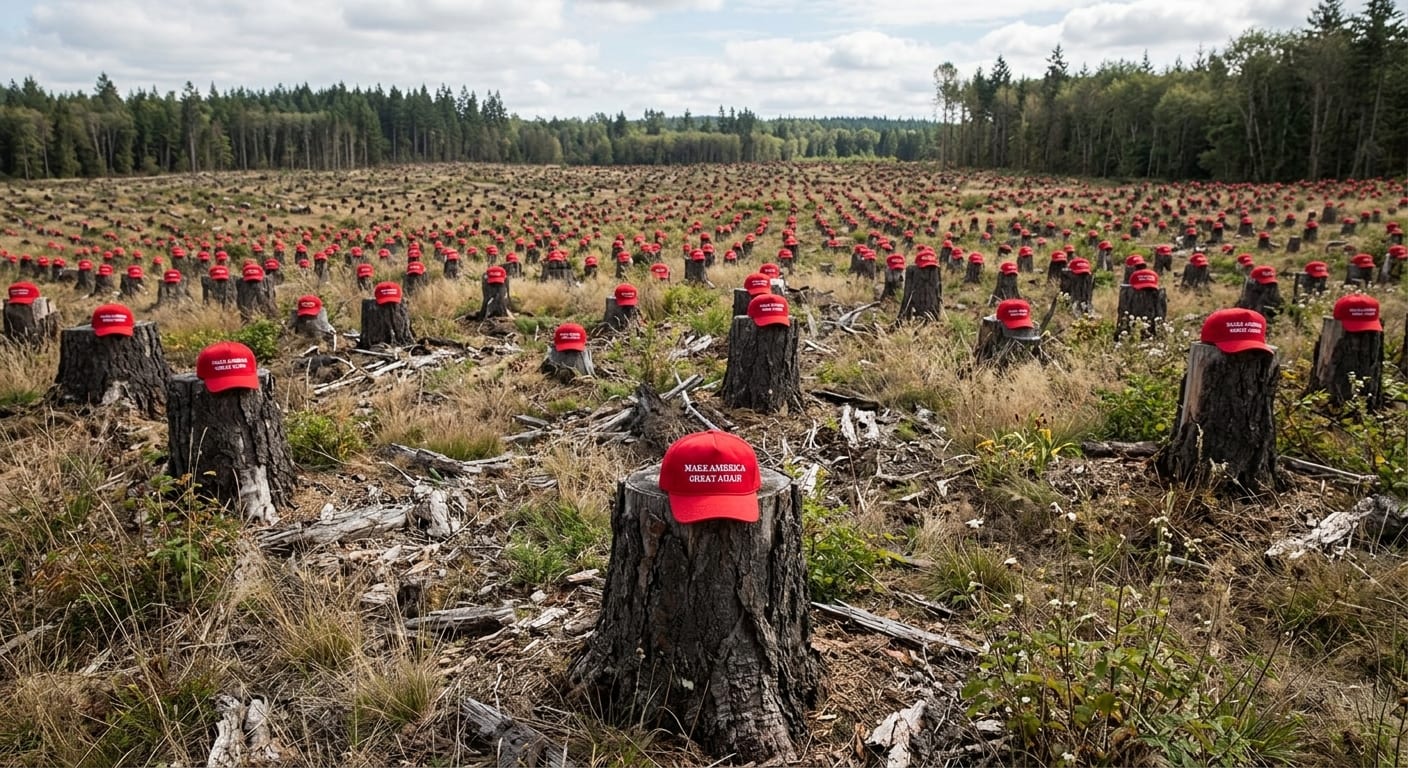
Right-wing political theater has become an ever-iterating slasher-movie franchise. While representing very different flavors of conservative demagogue, Elon Musk, Rand Paul, Brian Kemp, and Argentina’s Trump mini-me Javier Milei share a passion for the chainsaw as a political symbol. While ostensibly wielded as a death threat to “nanny-state” government, those who suffer the amputations are largely the ordinary citizens whom the state is charged with protecting.

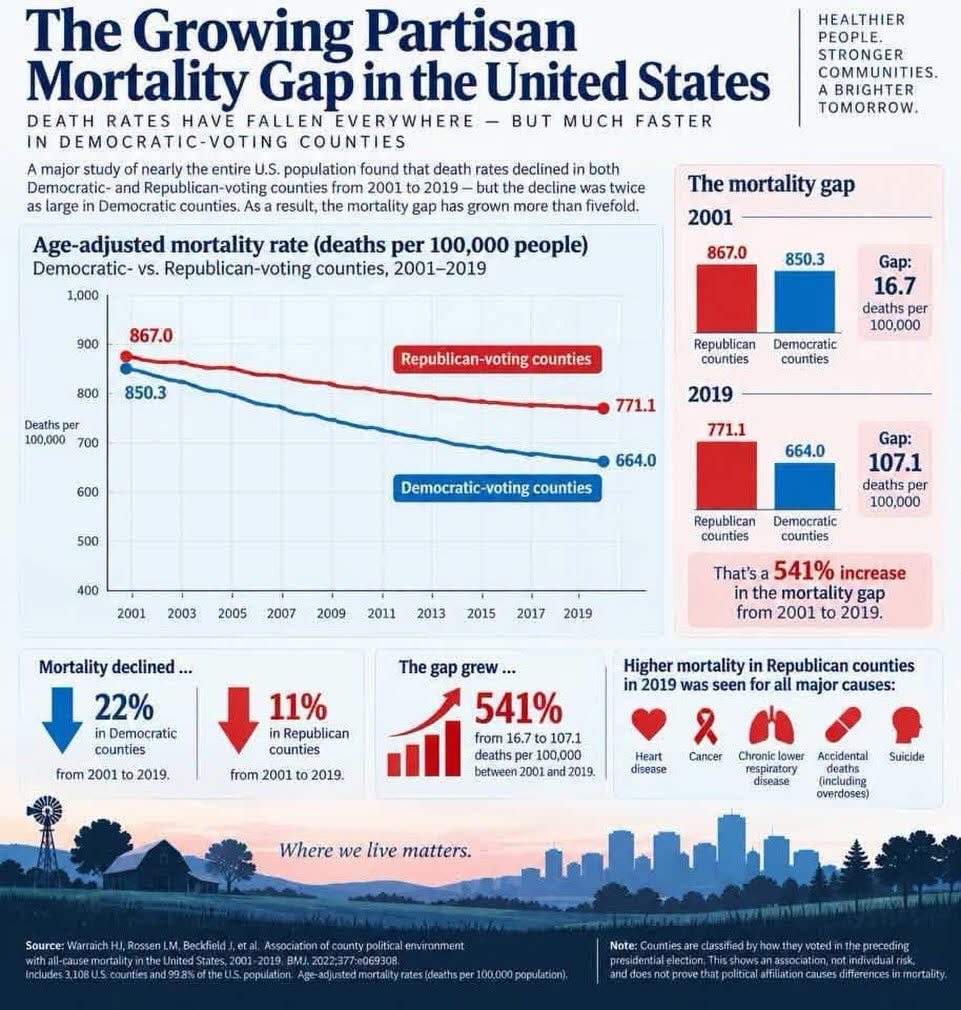
And the greatest lacerating irony is that the injuries – to medical care access, food security, housing, public health, air and water quality, and even life-span – are suffered most by conservative voters. In my 2024 book, Hatreds We Love, I lay out the grim statistics that show how Republican policies and rhetoric kill Republican voters. COVID, cancer, obstetric complications, and other maladies have all been exacerbated by the actions of GOP leaders. I cite a 2022 study published in the British Medical Journal showing that those who live in counties that elect Republicans are far more likely to have foreshortened lives from the top ten causes of death than those residing in areas represented by Democrats.
In the same chapter, I also describe a comprehensive, rigorous 2023 study on partisan differences in life expectancy. Controlling for income, education, urbanization, health care access, and race, the single determinative variable is whether people live in counties that spend tax dollars on public goods and services. The study’s authors point out that residents of red counties have life expectancies on par with people in El Salvador, Belarus, and Libya.
The disproportionate damage to the well-being of red-state citizens has only increased in the ensuing years. Republican abortion bans have created obstetrical care deserts to go along with their food deserts, local news deserts, and the growing climate-induced desertification of their landscapes. The exodus of OB docs from GOP states has been felt with painful acuity in Idaho, where a complication of pregnancy that might require a therapeutic abortion can be a death sentence for women.
The death rate from ectopic pregnancies in the US has doubled in the last five years, driven by the impediments to obstetrical treatment from abortion bans. That criminalization of reproductive choice was compounded by another assault of the budgetary chainsaw when the Trump Department of Health and Human Services slashed staffing and funding for maternal health care.
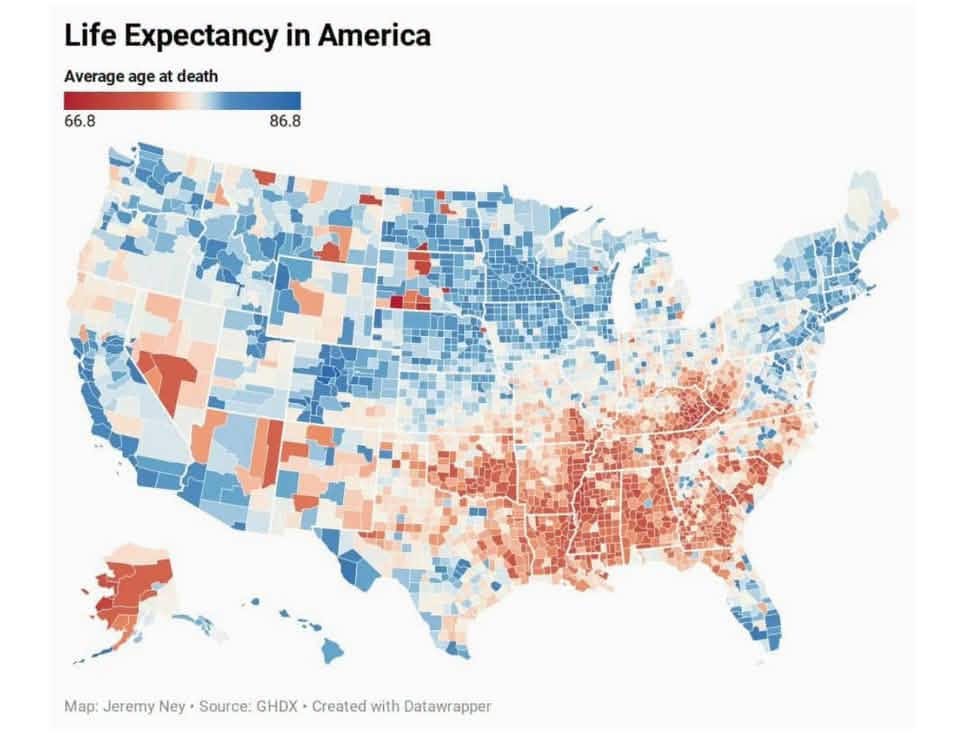
More broadly, Republican politicians are dramatically truncating the life expectancies of Americans, especially the lives of their constituents. Being a conservative voter in a red county has become a major risk factor for disease, disability, and death. A 2025 study published in Nature Human Behavior found shocking health outcome disparities between conservative and liberal Americans not accounted for by other demographic variables. Importantly, the authors argue that the higher mortality rate of Republican voters is not just the result of GOP policies, such as the deregulation of environmental pollutants, health and safety regulations, the defunding and diminished availability of health care, the legal sanctions against the provision of life-saving obstetrical treatments, the reductions in food safety inspections, and the diminished support for and access to vaccinations.
There is also a profound health cost incurred by internalizing a right-wing mindset, comprised of conservative beliefs and related cognitive biases. That mindset includes the devaluation of medical and other scientific expertise, the cultivation of paranoid and diverting delusions about the sources of illness and other threats, the denigration of fact-based information, and the promotion of credulity toward faith-based epistemologies – whether they be the claims of religious leaders or the mendacious pronouncements emanating from the White House.
Voting in Captivity
“MAGA is Stockholm Syndrome for those who don’t know where Stockholm is,” proclaimed a recent meme of unknown provenance. It was one of those brilliant, succinct, and acidic bits of resistance snark I wish I had authored. It also condenses some important psychological truths about the present moment, especially concerning the 29% of Americans who, despite all they’ve lost and will lose, still hitch their wagons to the lurching, delirious, and raving jackass taking the country over the steepest cliff he can find.
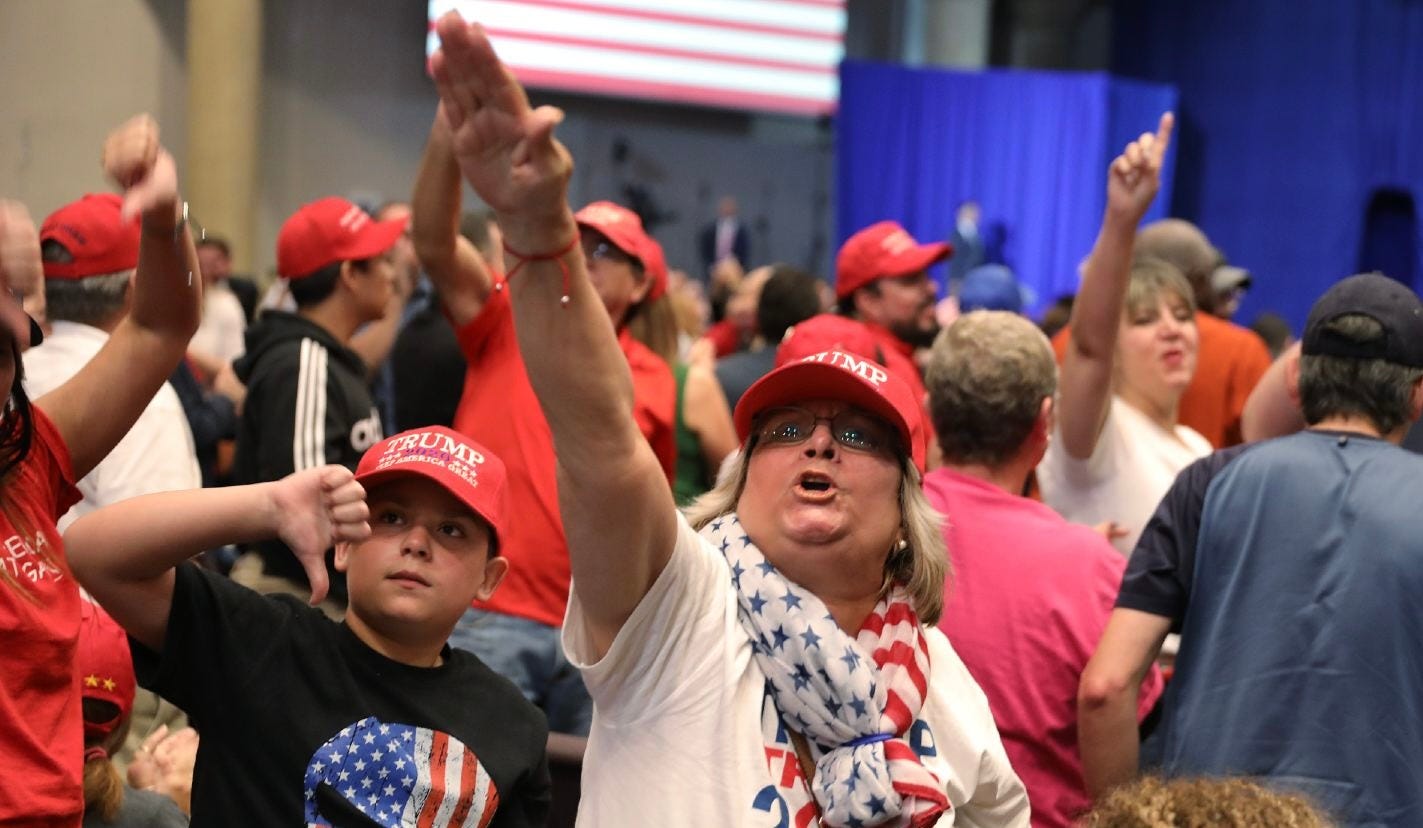
Whenever a new poll comes out showing Trump’s decreasing approval rating, I swing between two opposite reactions. My first thought is, “Hallelujah! America is finally coming to its senses and can see the naked emperor for the hideous corpulent excrescence he is!” A nanosecond later, I’m asking myself, “How the fuck can nearly a third of the country look at Trump and still think they are being led to the promised land by Holy King Jesus?” The answer to that question is also the explanation for the larger mystery of how people can be persuaded to vote against their material self-interest.
That vexing question has plagued my entire intellectual and political life and ultimately led me to research and write my recent book. For so long, I couldn’t understand the willingness of so many working and middle-class folks to elect politicians whose policies rendered their lives poorer, less free, and, as I’ve written here, sicker and shorter.
I Belong, Therefore I Am
Then, with Trump’s political rise and the delirious adoration he engendered in his base, something clicked for me. I realized how naïve I had been to think that material self-interest was the most powerful motive in politics. It became vividly apparent that membership in groups that give us a sense of meaning and identity—what I call tribes—drives political behavior far more than I had realized. Understanding that demystifies what might otherwise be glibly dismissed as electoral masochism. As we have all borne witness to, people will kill and die for their place in the group.
I use the word ‘tribe’ in the everyday sense to refer to the political and cultural groups we belong to. They comprise people with whom we share values, beliefs, and a real or imagined history.
Humans are and have always been deeply social beings. From our first gasp of air to our last, we live in a world of profound interdependence. Without others, we cannot be a self – physically or psychologically.
That said, partisans on the Left and the Right think very differently about what it means to be a tribe. While individual people can exist anywhere on the partisan spectrum and there are no pure types, in general, liberals and conservatives differ the most in their preferred form of group boundaries. For liberals, tribal borders are best when semi-permeable. Their instinct is to be xenophilic – to be curious about, attracted to, and selectively welcoming of novelty and outsiders. Conservatives tend to be more reflexively xenophobic – to mistrust, fear, and feel disgust for the unfamiliar and strangers. They prefer rigid, impermeable boundaries. Those on the Right are especially worried about borders that mark race, ethnicity, religion, sexuality, and gender.
That’s what made Trump’s “wall” such a powerful and motivating symbol for his base. Regardless of whether it ever became a real structure, it was the wall in the inner worlds of the MAGA base, the one that separated and defined “them” and “us,” that mattered most. Trump acknowledged and reinforced that wall. A psychopath with an intuitive talent for activating the atavistic xenophobic anxieties of the Republican base, he mobilized and directed their hatreds to serve his own interests and created an enduring cult of personality in the process.
To remain loyal members of MAGA and bask in the fantasy of his love, Trump’s followers obediently opposed politicians and policies that would improve their economic well-being, give them health insurance, protect them from disease, combat the climate crisis, and reduce their exposure to life-threatening environmental poisons. They also learned to blame tribal outsiders, like the chimerical dog-and-cat-eating Haitians, for their woes. And they came to accept their own fiscal, physical, and psychic pain in the comforting belief that their orange avenger was hurting despised others even more.
It is revealing to note that during the height of the pandemic, pharmacies around the country created backdoor entrances to vaccination rooms so that Republicans who were only publicly anti-vax could discreetly enter and get the jab without being seen by their fellow conservative friends and neighbors. Some even wore disguises. In other words, they were trying to prevent biological death without risking social death.
If the economic pain and increasing medical vulnerability suffered by that remaining 29% of devout Trump supporters can break the spell of their tribal bond with MAGA, the coming elections may be an opportunity for even more Americans to reconcile their biological wellbeing with their social vitality.
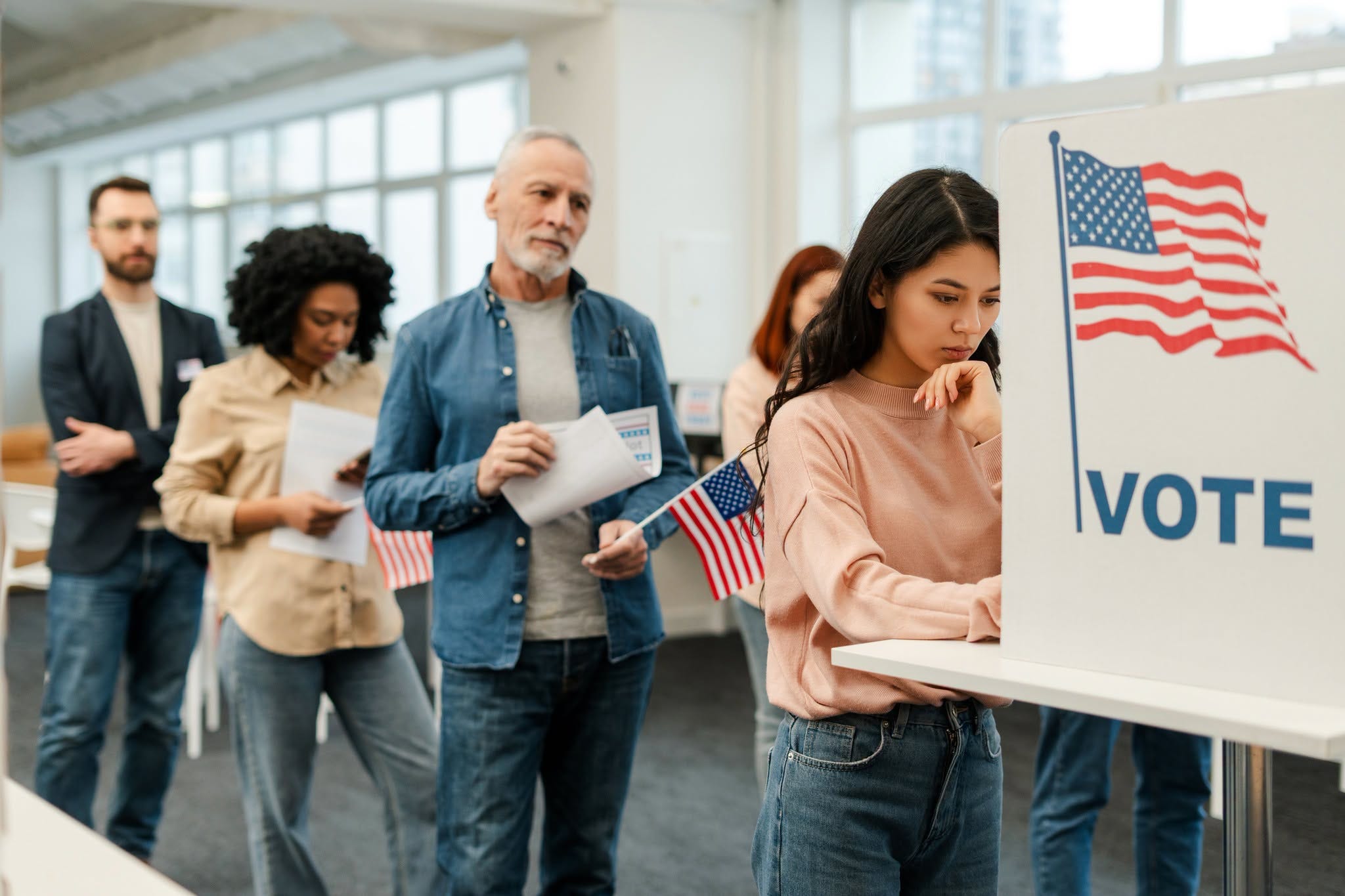
What interests me here is that “voting against your own interests” may be too narrow a way to frame it. People do not act only from economic self-interest. They also act from identity, belonging, status, recognition, fear of exclusion, and the need to remain part of a moral community.
Bourdieu helps explain this better than calling it “Stockholm syndrome.” Political identity can become part of habitus, tied to class, family, masculinity, religion, place, and social status. A person may accept material losses if the political identity still provides symbolic status or a sense of belonging.
That does not mean the policies are materially beneficial. It means the social reward can be powerful enough to compete with material self-interest.
The deeper question is not simply, “Why would people vote for the chainsaw?” It is: how did the chainsaw come to represent belonging, dignity, status, or being on the “right” side of the social hierarchy in the first place?